Showing posts with label brothers. Show all posts

Friday, December 8, 2017

Moses

Chapter 22 - Moses


This chapter is based on Exodus 1-4.

Audio

Online Reading

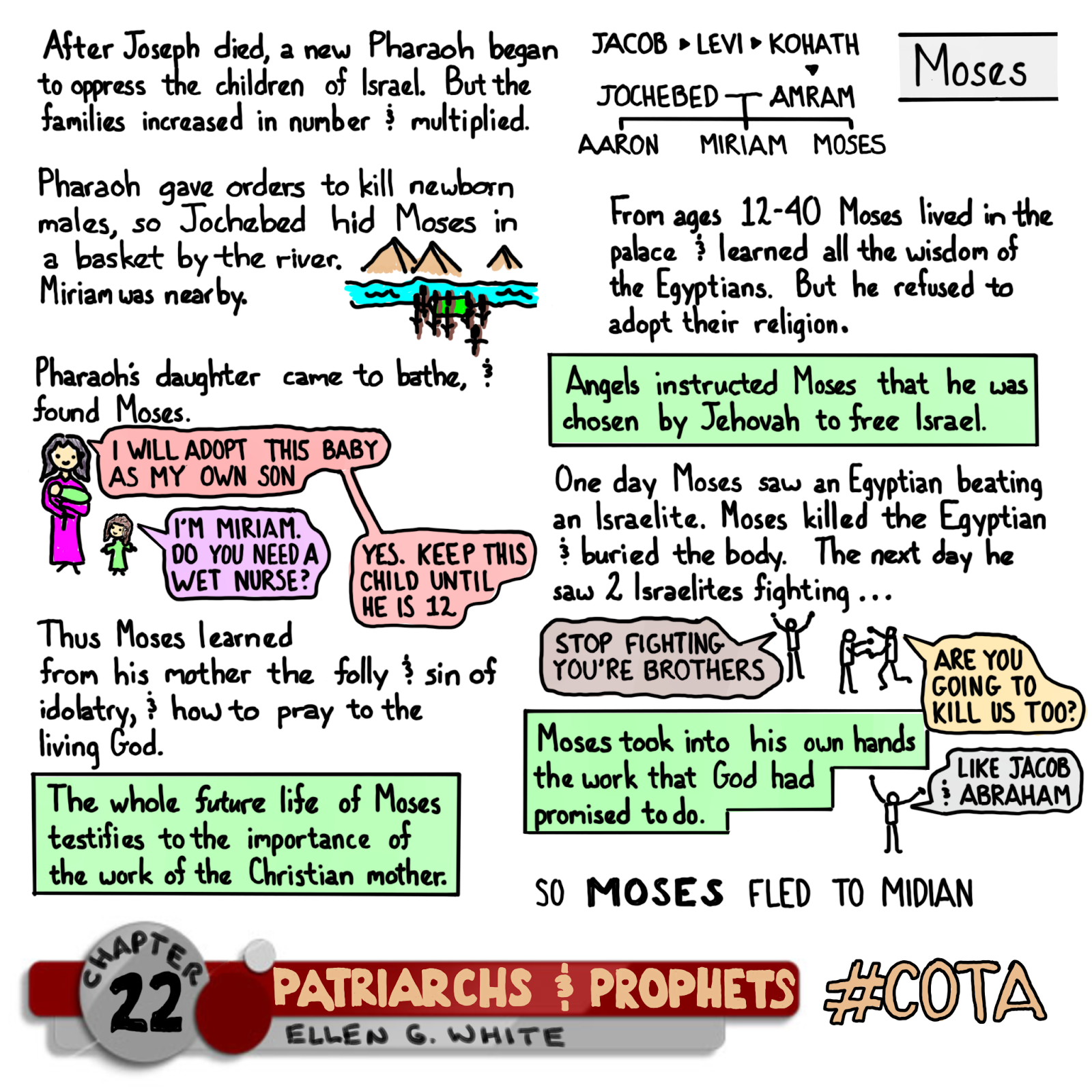
THE people of Egypt, in order to supply themselves with food during the famine, had sold to the crown their cattle and lands, and had finally bound themselves to perpetual serfdom. Joseph wisely provided for their release; he permitted them to become royal tenants, holding their lands of the king, and paying an annual tribute of one fifth of the products of their labor.

But the children of Jacob were not under the necessity of making such conditions. On account of the service that Joseph had rendered the Egyptian nation, they were not only granted a part of the country as a home, but were exempted from taxation, and liberally supplied with food during the continuance of the famine. The king publicly acknowledged that it was through the merciful interposition of the God of Joseph that Egypt enjoyed plenty while other nations were perishing from famine. He saw, too, that Joseph's management had greatly enriched the kingdom, and his gratitude surrounded the family of Jacob with royal favor.


Thursday, December 7, 2017

Joseph and His Brothers

Chapter 21 - Joseph and His Brothers


This chapter is based on Genesis 41:54-56; 42 to 50.

Audio

Online Reading

AT the very opening of the fruitful years began the preparation for the approaching famine. Under the direction of Joseph, immense storehouses were erected in all the principal places throughout the land of Egypt, and ample arrangements were made for preserving the surplus of the expected harvest. The same policy was continued during the seven years of plenty, until the amount of grain laid in store was beyond computation.

And now the seven years of dearth began to come, according to Joseph's prediction. "And the dearth was in all lands; but in all the land of Egypt there was bread. And when all the land of Egypt was famished, the people cried to Pharaoh for bread: and Pharaoh said unto all the Egyptians, Go unto Joseph; what he saith to you, do. And the famine was over all the face of the earth: and Joseph opened all the storehouses, and sold unto the Egyptians."


Thursday, November 30, 2017

The Return to Canaan

Chapter 19 - The Return to Canaan

This chapter is based on Genesis 34, 35, and 37.

Audio

Online Reading

CROSSING the Jordan, "Jacob came in peace to the city of Shechem, which is in the land of Canaan." Genesis 33:18, R.V. Thus the patriarch's prayer at Bethel, that God would bring him again in peace to his own land, had been granted. For a time he dwelt in the vale of Shechem. It was here that Abraham, more than a hundred years before, had made his first encampment and erected his first altar in the Land of Promise. Here Jacob "bought the parcel of ground where he had spread his tent, at the hand of the children of Hamor, Shechem's father, for a hundred pieces of money. And he erected there an altar, and called it El-elohe-Israel" (verses 19, 20)--God, the God of Israel." Like Abraham, Jacob set up beside his tent an altar unto the Lord, calling the members of his household to the morning and the evening sacrifice. It was here also that he dug the well to which, seventeen centuries later, came Jacob's Son and Saviour, and beside which, resting during the noontide heat, He told His wondering hearers of that "well of water springing up into everlasting life." John 4:14.

The tarry of Jacob and his sons at Shechem ended in violence and bloodshed. The one daughter of the household had been brought to shame and sorrow, two brothers were involved in the guilt of murder, a whole city had been given to ruin and slaughter, in retaliation for the lawless deed of one rash youth. The beginning that led to results so terrible was the act of Jacob's daughter, who "went out to see the daughters of the land," thus venturing into association with the ungodly. He who seeks pleasure among those that fear not God is placing himself on Satan's ground and inviting his temptations.


Tuesday, November 28, 2017

Night of Wrestling

Chapter 18 - The Night of Wrestling


This chapter is based on Genesis 32 and 33.

Audio

Online Reading

THOUGH Jacob had left Padan-aram in obedience to the divine direction, it was not without many misgivings that he retraced the road which he had trodden as a fugitive twenty years before. His sin in the deception of his father was ever before him. He knew that his long exile was the direct result of that sin, and he pondered over these things day and night, the reproaches of an accusing conscience making his journey very sad. As the hills of his native land appeared before him in the distance, the heart of the patriarch was deeply moved. All the past rose vividly before him. With the memory of his sin came also the thought of God's favor toward him, and the promises of divine help and guidance.

As he drew nearer his journey's end, the thought of Esau brought many a troubled foreboding. After the flight of Jacob, Esau had regarded himself as the sole heir of their father's possessions. The news of Jacob's return would excite the fear that he was coming to claim the inheritance. Esau was now able to do his brother great injury, if so disposed, and he might be moved to violence against him, not only by the desire for revenge, but in order to secure undisturbed possession of the wealth which he had so long looked upon as his own.


Sunday, November 26, 2017

Jacob and His Children

Through no fault of his own, Jacob ended up with two wives, plus two concubines. As a result, the children of Jacob comprised a mix of ages and mothers. Jacob had twelve sons and one daughter.

I found it helpful to keep track using a list of children grouped by wife or concubine. Below is my sketch note attempt to illustrate Jacob's family. Of course, these are not accurate representations, but I chose to match siblings with mothers using matching hair colors.

Genesis 29:31-30:24; 35:16-18 provides all of the narrative detail.


Thursday, November 16, 2017

Jacob and Esau

Chapter 16 - Jacob and Esau


This chapter is based on Genesis 25:19-34; 27.

Audio

Online Reading

JACOB and Esau, the twin sons of Isaac, present a striking contrast, both in character and in life. This unlikeness was foretold by the angel of God before their birth. When in answer to Rebekah's troubled prayer he declared that two sons would be given her, he opened to her their future history, that each would become the head of a mighty nation, but that one would be greater than the other, and that the younger would have the pre-eminence.

Esau grew up loving self-gratification and centering all his interest in the present. Impatient of restraint, he delighted in the wild freedom of the chase, and early chose the life of a hunter. Yet he was the father's favorite. The quiet, peace-loving shepherd was attracted by the daring and vigor of this elder son, who fearlessly ranged over mountain and desert, returning home with game for his father and with exciting accounts of his adventurous life. Jacob, thoughtful, diligent, and care-taking, ever thinking more of the future than the present, was content to dwell at home, occupied in the care of the flocks and the tillage of the soil. His patient perseverance, thrift, and foresight were valued by the mother. His affections were deep and strong, and his gentle, unremitting attentions added far more to her happiness than did the boisterous and occasional kindnesses of Esau. To Rebekah, Jacob was the dearer son.


Tuesday, November 7, 2017

The Test of Faith

Chapter 13: The Test of Faith


This chapter is based on Genesis 16; 17:18-20; 21:1-14; 22:1-19.

Audio

Online Reading

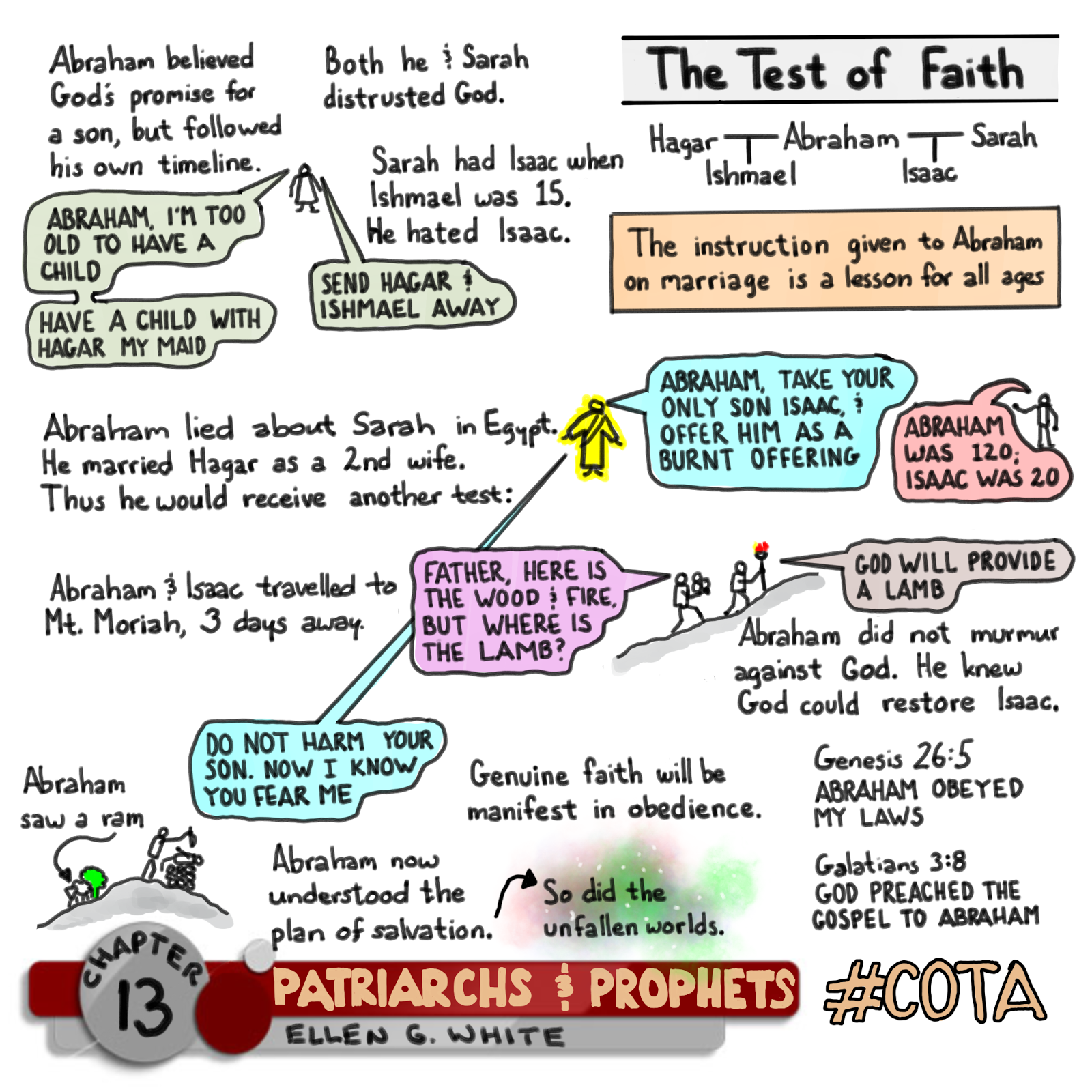
ABRAHAM had accepted without question the promise of a son, but he did not wait for God to fulfill His word in His own time and way. A delay was permitted, to test his faith in the power of God; but he failed to endure the trial. Thinking it impossible that a child should be given her in her old age, Sarah suggested, as a plan by which the divine purpose might be fulfilled, that one of her handmaidens should be taken by Abraham as a secondary wife. Polygamy had become so widespread that it had ceased to be regarded as a sin, but it was no less a violation of the law of God, and was fatal to the sacredness and peace of the family relation. Abraham's marriage with Hagar resulted in evil, not only to his own household, but to future generations.

Flattered with the honor of her new position as Abraham's wife, and hoping to be the mother of the great nation to descend from him, Hagar became proud and boastful, and treated her mistress with contempt. Mutual jealousies disturbed the peace of the once happy home. Forced to listen to the complaints of both, Abraham vainly endeavored to restore harmony. Though it was at Sarah's earnest entreaty that he had married Hagar, she now reproached him as the one at fault. She desired to banish her rival; but Abraham refused to permit this; for Hagar was to be the mother of this child, as he fondly hoped, the son of promise. She was Sarah's servant, however, and he still left her to the control of her mistress. Hagar's haughty spirit would not brook the harshness which her insolence had provoked. "When Sarai dealt hardly with her, she fled from her face."


Sunday, November 5, 2017

Abraham in Canaan

Chapter 12 - Abraham in Canaan


This chapter is based on Genesis 13-15; 17:1-16; 18.

Audio

Online Reading

ABRAHAM returned to Canaan "very rich in cattle, in silver, and in gold." Lot was still with him, and again they came to Bethel, and pitched their tents by the altar which they had before erected. They soon found that increased possessions brought increased trouble. In the midst of hardships and trials they had dwelt together in harmony, but in their prosperity there was danger of strife between them. The pasturage was not sufficient for the flocks and herds of both, and the frequent disputes among the herdsmen were brought for settlement to their masters. It was evident that they must separate. Abraham was Lot's senior in years, and his superior in relation, in wealth, and in position; yet he was the first to propose plans for preserving peace. Although the whole land had been given him by God Himself, he courteously waived this right.

"Let there be no strife," he said, "between me and thee, and between my herdmen and thy herdmen; for we be brethren. Is not the whole land before thee? separate thyself, I pray thee, from me: if thou wilt take the left hand, then I will go to the right; or if thou depart to the right hand, then I will go to the left."


Thursday, October 26, 2017

The Tower of Babel

Chapter 10 - The Tower of Babel


This chapter is based on Genesis 9:25-27 and 11:1-9.

Audio

Online Reading

TO repeople the desolate earth, which the Flood had so lately swept from its moral corruption, God had preserved but one family, the household of Noah, to whom He had declared, "Thee have I seen righteous before Me in this generation." Genesis 7:1. Yet in the three sons of Noah was speedily developed the same great distinction seen in the world before the Flood. In Shem, Ham, and Japheth, who were to be the founders of the human race, was foreshadowed the character of their posterity.

Noah, speaking by divine inspiration, foretold the history of the three great races to spring from these fathers of mankind. Tracing the descendants of Ham, through the son rather than the father, he declared, "Cursed be Canaan; a servant of servants shall he be unto his brethren." The unnatural crime of Ham declared that filial reverence had long before been cast from his soul, and it revealed the impiety and vileness of his character. These evil characteristics were perpetuated in Canaan and his posterity, whose continued guilt called upon them the judgments of God.


Thursday, October 12, 2017

Cain and Abel Tested

Chapter 5: Cain and Abel Tested


This chapter is based on Genesis 4:1-15.

Audio

Online Reading

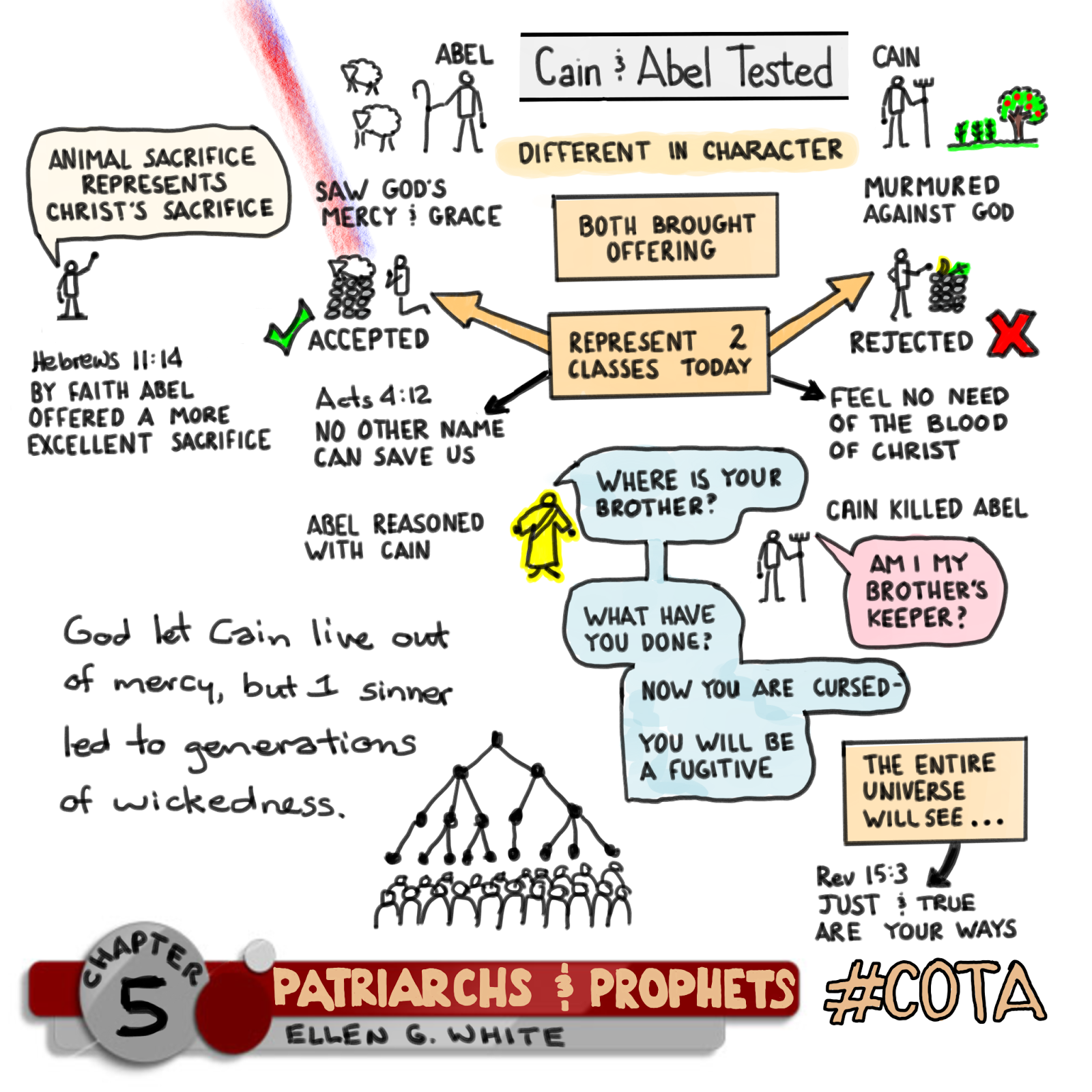
CAIN and Abel, the sons of Adam, differed widely in character. Abel had a spirit of loyalty to God; he saw justice and mercy in the Creator's dealings with the fallen race, and gratefully accepted the hope of redemption. But Cain cherished feelings of rebellion, and murmured against God because of the curse pronounced upon the earth and upon the human race for Adam's sin. He permitted his mind to run in the same channel that led to Satan's fall--indulging the desire for self-exaltation and questioning the divine justice and authority.

These brothers were tested, as Adam had been tested before them, to prove whether they would believe and obey the word of God. They were acquainted with the provision made for the salvation of man, and understood the system of offerings which God had ordained. They knew that in these offerings they were to express faith in the Saviour whom the offerings typified, and at the same time to acknowledge their total dependence on Him for pardon; and they knew that by thus conforming to the divine plan for their redemption, they were giving proof of their obedience to the will of God. Without the shedding of blood there could be no remission of sin; and they were to show their faith in the blood of Christ as the promised atonement by offering the firstlings of the flock in sacrifice. Besides this, the first fruits of the earth were to be presented before the Lord as a thank offering.