Showing posts with label conflictoftheages. Show all posts

Thursday, March 1, 2018

Balaam

This chapter is based on Numbers 22 and 24.

Audio

Online Reading

RETURNING to the Jordan from the conquest of Bashan, the Israelites, in preparation for the immediate invasion of Canaan, encamped beside the river, above its entrance into the Dead Sea, and just opposite the plain of Jericho. They were upon the very borders of Moab, and the Moabites were filled with terror at the close proximity of the invaders.

The people of Moab had not been molested by Israel, yet they had watched with troubled forebodings all that had taken place in the surrounding countries. The Amorites, before whom they had been forced to retreat, had been conquered by the Hebrews, and the territory which the Amorites had wrested from Moab was now in the possession of Israel. The hosts of Bashan had yielded before the mysterious power enshrouded in the cloudy pillar, and the giant strongholds were occupied by the Hebrews. The Moabites dared not risk an attack upon them; an appeal to arms was hopeless in face of the supernatural agencies that wrought in their behalf. But they determined, as Pharaoh had done, to enlist the power of sorcery to counteract the work of God. They would bring a curse upon Israel.


Monday, February 26, 2018

Conquest of Bashan

This chapter is based on Deuteronomy 2 and 3:1-11.

Audio

Online Reading

AFTER passing to the south of Edom, the Israelites turned northward, and again set their faces toward the Promised Land. Their route now lay over a vast, elevated plain, swept by cool, fresh breezes from the hills. It was a welcome change from the parched valley through which they had been traveling, and they pressed forward, buoyant and hopeful. Having crossed the brook Zered, they passed to the east of the land of Moab; for the command had been given, "Distress not the Moabites, neither contend with them in battle: for I will not give thee of their land for a possession; because I have given Ar unto the children of Lot." And the same direction was repeated concerning the Ammonites, who were also descendants of Lot.

Still pushing northward, the hosts of Israel soon reached the country of the Amorites. This strong and warlike people originally occupied the southern part of the land of Canaan; but, increasing in numbers, they crossed the Jordan, made war upon the Moabites, and gained possession of a portion of their territory. Here they had settled, holding undisputed sway over all the land from the Arnon as far north as the Jabbok. The route to the Jordan which the Israelites desired to pursue lay directly through this territory, and Moses sent a friendly message to Sihon, the Amorite king, at his capital: "Let me pass through thy land: I will go along by the highway, I will neither turn unto the right hand nor to the left. Thou shalt sell me meat for money, that I may eat; and give me water for money, that I may drink: only I will pass through on my feet." The answer was a decided refusal, and all the hosts of the Amorites were summoned to oppose the progress of the invaders. This formidable army struck terror to the Israelites, who were poorly prepared for an encounter with well-armed and well-disciplined forces. So far as skill in warfare was concerned, their enemies had the advantage. To all human appearance, a speedy end would be made of Israel.


Thursday, February 8, 2018

The Journey Around Edom

This chapter is based on Numbers 20:14-29 and 21:1-9.

Audio

Online Reading

THE encampment of Israel at Kadesh was but a short distance from the borders of Edom, and both Moses and the people greatly desired to follow the route through this country to the Promised Land; accordingly they sent a message, as God had directed them, to the Edomite king--

"Thus saith thy brother Israel, Thou knowest all the travail that hath befallen us: how our fathers went down into Egypt, and we have dwelt in Egypt a long time; and the Egyptians vexed us, and our fathers: and when we cried unto the Lord, He heard our voice, and sent an Angel, and hath brought us forth out of Egypt: and, behold, we are in Kadesh, a city in the uttermost of thy border. Let us pass, I pray thee, through thy country: we will not pass through the fields, or through the vineyards, neither will we drink of the water of the wells: we will go by the king's highway, we will not turn to the right hand nor to the left, until we have passed thy borders."


Monday, February 5, 2018

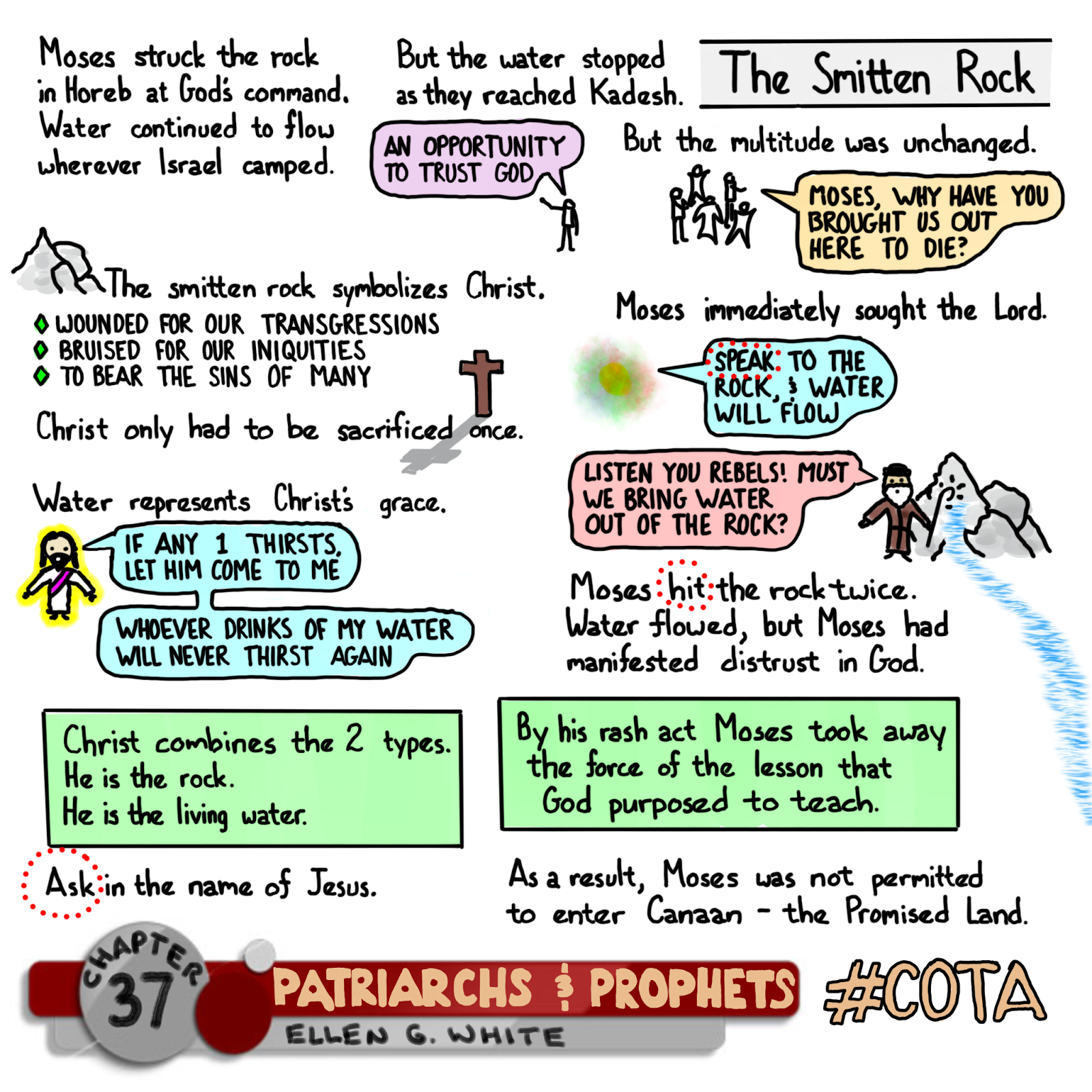
The Smitten Rock

This chapter is based on Numbers 20:1-13.

Audio

Online Reading

FROM the smitten rock in Horeb first flowed the living stream that refreshed Israel in the desert. During all their wanderings, wherever the need existed, they were supplied with water by a miracle of God's mercy. The water did not, however, continue to flow from Horeb. Wherever in their journeyings they wanted water, there from the clefts of the rock it gushed out beside their encampment.

It was Christ, by the power of His word, that caused the refreshing stream to flow for Israel. "They drank of that spiritual Rock that followed them: and that Rock was Christ." 1 Corinthians 10:4. He was the source of all temporal as well as spiritual blessings. Christ, the true Rock, was with them in all their wanderings. "They thirsted not when He led them through the deserts: He caused the waters to flow out of the rock for them; He clave the rock also, and the waters gushed out." "They ran in the dry places like a river." Isaiah 48:21; Psalm 105:41.


Tuesday, January 30, 2018

In the Wilderness

Audio

Online Reading

FOR nearly forty years the children of Israel are lost to view in the obscurity of the desert. "The space," says Moses, "in which we came from Kadesh-barnea, until we were come over the brook Zered, was thirty and eight years; until all the generation of the men of war were wasted out from among the host, as the Lord sware unto them. For indeed the hand of the Lord was against them, to destroy them from among the host, until they were consumed." Deuteronomy 2:14, 15.

During these years the people were constantly reminded that they were under the divine rebuke. In the rebellion at Kadesh they had rejected God, and God had for the time rejected them. Since they had proved unfaithful to His covenant, they were not to receive the sign of the covenant, the rite of circumcision. Their desire to return to the land of slavery had shown them to be unworthy of freedom, and the ordinance of the Passover, instituted to commemorate the deliverance from bondage, was not to be observed.


Sunday, January 28, 2018

Rebellion of Korah

This chapter is based on Numbers 16 and 17.

Audio

Online Reading

THE judgments visited upon the Israelites served for a time to restrain their murmuring and insubordination, but the spirit of rebellion was still in the heart and eventually brought forth the bitterest fruits. The former rebellions had been mere popular tumults, arising from the sudden impulse of the excited multitude; but now a deep-laid conspiracy was formed, the result of a determined purpose to overthrow the authority of the leaders appointed by God Himself.

Korah, the leading spirit in this movement, was a Levite, of the family of Kohath, and a cousin of Moses; he was a man of ability and influence. Though appointed to the service of the tabernacle, he had become dissatisfied with his position and aspired to the dignity of the priesthood. The bestowal upon Aaron and his house of the priestly office, which had formerly devolved upon the first-born son of every family, had given rise to jealousy and dissatisfaction, and for some time Korah had been secretly opposing the authority of Moses and Aaron, though he had not ventured upon any open act of rebellion. He finally conceived the bold design of overthrowing both the civil and the religious authority. He did not fail to find sympathizers. Close to the tents of Korah and the Kohathites, on the south side of the tabernacle, was the encampment of the tribe of Reuben, the tents of Dathan and Abiram, two princes of this tribe, being near that of Korah. These princes readily joined in his ambitious schemes. Being descendants from the eldest son of Jacob, they claimed that the civil authority belonged to them, and they determined to divide with Korah the honors of the priesthood.


Thursday, January 25, 2018

Twelve Spies

This chapter is based on Numbers 13 and 14.

Audio

Online Reading

ELEVEN days after leaving Mount Horeb the Hebrew host encamped at Kadesh, in the wilderness of Paran, which was not far from the borders of the Promised Land. Here it was proposed by the people that spies be sent up to survey the country. The matter was presented before the Lord by Moses, and permission was granted, with the direction that one of the rulers of each tribe should be selected for this purpose. The men were chosen as had been directed, and Moses bade them go and see the country, what it was, its situation and natural advantages; and the people that dwelt therein, whether they were strong or weak, few or many; also to observe the nature of the soil and its productiveness and to bring of the fruit of the land.

They went, and surveyed the whole land, entering at the southern border and proceeding to the northern extremity. They returned after an absence of forty days. The people of Israel were cherishing high hopes and were waiting in eager expectancy. The news of the spies' return was carried from tribe to tribe and was hailed with rejoicing. The people rushed out to meet the messengers, who had safely escaped the dangers of their perilous undertaking. The spies brought specimens of the fruit, showing the fertility of the soil. It was in the time of ripe grapes, and they brought a cluster of grapes so large that it was carried between two men. They also brought of the figs and pomegranates which grew there in abundance.


Tuesday, January 23, 2018

From Sinai to Kadesh

This chapter is based on Numbers 11 and 12.

Audio

Online Reading

THE building of the tabernacle was not begun for some time after Israel arrived at Sinai; and the sacred structure was first set up at the opening of the second year from the Exodus. This was followed by the consecration of the priests, the celebration of the Passover, the numbering of the people, and the completion of various arrangements essential to their civil or religious system, so that nearly a year was spent in the encampment at Sinai. Here their worship had taken a more definite form, the laws had been given for the government of the nation, and a more efficient organization had been effected preparatory to their entrance into the land of Canaan.

The government of Israel was characterized by the most thorough organization, wonderful alike for its completeness and its simplicity. The order so strikingly displayed in the perfection and arrangement of all God's created works was manifest in the Hebrew economy. God was the center of authority and government, the sovereign of Israel. Moses stood as their visible leader, by God's appointment, to administer the laws in His name. From the elders of the tribes a council of seventy was afterward chosen to assist Moses in the general affairs of the nation. Next came the priests, who consulted the Lord in the sanctuary. Chiefs, or princes, ruled over the tribes. Under these were "captains over thousands, and captains over hundreds, and captains over fifties, and captains over tens," and, lastly, officers who might be employed for special duties. Deuteronomy 1:15.


Sunday, January 21, 2018

Law and the Covenants

Audio

Online Reading

ADAM and Eve, at their creation, had a knowledge of the law of God; they were acquainted with its claims upon them; its precepts were written upon their hearts. When man fell by transgression the law was not changed, but a remedial system was established to bring him back to obedience. The promise of a Saviour was given, and sacrificial offerings pointing forward to the death of Christ as the great sin offering were established. But had the law of God never been transgressed, there would have been no death, and no need of a Saviour; consequently there would have been no need of sacrifices.

Adam taught his descendants the law of God, and it was handed down from father to son through successive generations. But notwithstanding the gracious provision for man's redemption, there were few who accepted it and rendered obedience. By transgression the world became so vile that it was necessary to cleanse it by the Flood from its corruption. The law was preserved by Noah and his family, and Noah taught his descendants the Ten Commandments. As men again departed from God, the Lord chose Abraham, of whom He declared, "Abraham obeyed My voice, and kept My charge, My commandments, My statutes, and My laws." Genesis 26:5. To him was given the rite of circumcision, which was a sign that those who received it were devoted to the service of God--a pledge that they would remain separate from idolatry, and would obey the law of God. The failure of Abraham's descendants to keep this pledge, as shown in their disposition to form alliances with the heathen and adopt their practices, was the cause of their sojourn and bondage in Egypt. But in their intercourse with idolaters, and their forced submission to the Egyptians, the divine precepts became still further corrupted with the vile and cruel teachings of heathenism.


Thursday, January 18, 2018

Sin of Nadab and Abihu

This chapter is based on Leviticus 10:1-11.

Audio

Online Reading

AFTER the dedication of the tabernacle, the priests were consecrated to their sacred office. These services occupied seven days, each marked by special ceremonies. On the eight day they entered upon their ministration. Assisted by his sons, Aaron offered the sacrifices that God required, and he lifted up his hands and blessed the people. All had been done as God commanded, and He accepted the sacrifice, and revealed His glory in a remarkable manner; fire came from the Lord and consumed the offering upon the altar. The people looked upon this wonderful manifestation of divine power with awe and intense interest. They saw in it a token of God's glory and favor, and they raised a universal shout of praise and adoration and fell on their faces as if in the immediate presence of Jehovah.

But soon afterward a sudden and terrible calamity fell upon the family of the high priest. At the hour of worship, as the prayers and praise of the people were ascending to God, two of the sons of Aaron took each his censer and burned fragrant incense thereon, to rise as a sweet odor before the Lord. But they transgressed His command by the use of "strange fire." For burning the incense they took common instead of the sacred fire which God Himself had kindled, and which He had commanded to be used for this purpose. For this sin a fire went out from the Lord and devoured them in the sight of the people.


Sunday, January 14, 2018

Satan's Enmity Against the Law

Audio

Online Reading

THE very first effort of Satan to overthrow God's law--undertaken among the sinless inhabitants of heaven--seemed for a time to be crowned with success. A vast number of the angels were seduced; but Satan's apparent triumph resulted in defeat and loss, separation from God, and banishment from heaven.

When the conflict was renewed upon the earth, Satan again won a seeming advantage. By transgression, man became his captive, and man's kingdom also was betrayed into the hands of the archrebel. Now the way seemed open for Satan to establish an independent kingdom, and to defy the authority of God and His Son. But the plan of salvation made it possible for man again to be brought into harmony with God, and to render obedience to His law, and for both man and the earth to be finally redeemed from the power of the wicked one.


Thursday, January 11, 2018

Idolatry at Sinai

This chapter is based on Exodus 32-34.

Audio

Online Reading

WHILE Moses was absent it was a time of waiting and suspense to Israel. The people knew that he had ascended the mount with Joshua, and had entered the cloud of thick darkness which could be seen from the plain below, resting on the mountain peak, illuminated from time to time with the lightnings of the divine Presence. They waited eagerly for his return. Accustomed as they had been in Egypt to material representations of deity, it had been hard for them to trust in an invisible being, and they had come to rely upon Moses to sustain their faith. Now he was taken from them. Day after day, week after week passed, and still he did not return. Notwithstanding the cloud was still in view, it seemed to many in the camp that their leader had deserted them, or that he had been consumed by the devouring fire.

During this period of waiting, there was time for them to meditate upon the law of God which they had heard, and to prepare their hearts to receive the further revelations that He might make to them. They had none too much time for this work; and had they been thus seeking a clearer understanding of God's requirements, and humbling their hearts before Him, they would have been shielded from temptation. But they did not do this, and they soon became careless, inattentive, and lawless. Especially was this the case with the mixed multitude. They were impatient to be on their way to the Land of Promise--the land flowing with milk and honey. It was only on condition of obedience that the goodly land was promised them, but they had lost sight of this. There were some who suggested a return to Egypt, but whether forward to Canaan or backward to Egypt, the masses of the people were determined to wait no longer for Moses.


Tuesday, January 9, 2018

Law Given to Israel

This chapter is based on Exodus 19-24.

Audio

Online Reading

SOON after the encampment at Sinai, Moses was called up into the mountain to meet with God. Alone he climbed the steep and rugged path, and drew near to the cloud that marked the place of Jehovah's presence. Israel was now to be taken into a close and peculiar relation to the Most High--to be incorporated as a church and a nation under the government of God. The message to Moses for the people was:

"Ye have seen what I did unto the Egyptians, and how I bare you on eagles' wings, and brought you unto Myself. Now therefore, if ye will obey My voice indeed, and keep My covenant, then ye shall be a peculiar treasure unto Me above all people: for all the earth is Mine: and ye shall be unto Me a kingdom of priests, and an holy nation."


Thursday, January 4, 2018

From the Red Sea to Sinai

This chapter is based on Exodus 15:22-27 and 16-18.

Audio

Online Reading

FROM the Red Sea the hosts of Israel again set forth on their journey, under the guidance of the pillar of cloud. The scene around them was most dreary--bare, desolate-looking mountains, barren plains, and the sea stretching far away, its shores strewn with the bodies of their enemies; yet they were full of joy in the consciousness of freedom, and every thought of discontent was hushed.

But for three days, as they journeyed, they could find no water. The supply which they had taken with them was exhausted. There was nothing to quench their burning thirst as they dragged wearily over the sun-burnt plains. Moses, who was familiar with this region, knew what the others did not, that at Marah, the nearest station where springs were to be found, the water was unfit for use. With intense anxiety he watched the guiding cloud. With a sinking heart he heard the glad shout. "Water! water!" echoed along the line. Men, women, and children in joyous haste crowded to the fountain, when, lo, a cry of anguish burst forth from the host--the water was bitter.

Thursday, December 14, 2017

The Exodus

Chapter 25 - The Exodus


This chapter is based on Exodus 12:34-51; 13 to 15.

Audio

Online Reading

WITH their loins girt, with sandaled feet, and staff in hand, the people of Israel had stood, hushed, awed, yet expectant, awaiting the royal mandate that should bid them go forth. Before the morning broke, they were on their way. During the plagues, as the manifestation of God's power had kindled faith in the hearts of the bondmen and had struck terror to their oppressors, the Israelites had gradually assembled themselves in Goshen; and notwithstanding the suddenness of their flight, some provision had already been made for the necessary organization and control of the moving multitudes, they being divided into companies, under appointed leaders.

And they went out, "about six hundred thousand on foot that were men, beside children. And a mixed multitude went up also with them." In this multitude were not only those who were actuated by faith in the God of Israel, but also a far greater number who desired only to escape from the plagues, or who followed in the wake of the moving multitudes merely from excitement and curiosity. This class were ever a hindrance and a snare to Israel.


Tuesday, December 12, 2017

The Passover

Chapter 24 - The Passover


This chapter is based on Exodus 11 and 12:1-32.

Audio

Online Reading

WHEN the demand for Israel's release had been first presented to the king of Egypt, the warning of the most terrible of the plagues had been given. Moses was directed to say to Pharaoh, "Thus saith the Lord, Israel is My son, even My first-born: and I say unto thee, Let My son go, that he may serve Me: and if thou refuse to let him go, behold, I will slay thy son, even thy first-born." Exodus 4:22, 23. Though despised by the Egyptians, the Israelites had been honored by God, in that they were singled out to be the depositaries of His law. In the special blessings and privileges accorded them, they had pre-eminence among the nations, as the first-born son had among brothers.

The judgment of which Egypt had first been warned, was to be the last visited. God is long-suffering and plenteous in mercy. He has a tender care for the beings formed in His image. If the loss of their harvests and their flocks and herds had brought Egypt to repentance, the children would not have been smitten; but the nation had stubbornly resisted the divine command, and now the final blow was about to fall.


Sunday, December 10, 2017

The Plagues of Egypt

Chapter 23 - The Plagues of Egypt


This chapter is based on Exodus 5-10.

Audio

Online Reading

AARON, being instructed by angels, went forth to meet his brother, from whom he had been so long separated; and they met amid the desert solitudes, near Horeb. Here they communed together, and Moses told Aaron "all the words of the Lord who had sent him, and all the signs which He had commanded him." Exodus 4:28. Together they journeyed to Egypt; and having reached the land of Goshen, they proceeded to assemble the elders of Israel. Aaron repeated to them all the dealings of God with Moses, and then the signs which God had given Moses were shown before the people. "The people believed: and when they heard that the Lord had visited the children of Israel, and that He had looked upon their affliction, then they bowed their heads and worshiped." Verse 31.

Moses had been charged also with a message for the king. The two brothers entered the palace of the Pharaohs as ambassadors from the King of kings, and they spoke in His name: "Thus saith Jehovah, God of Israel, Let My people go, that they may hold a feast unto Me in the wilderness."


Friday, December 8, 2017

Moses

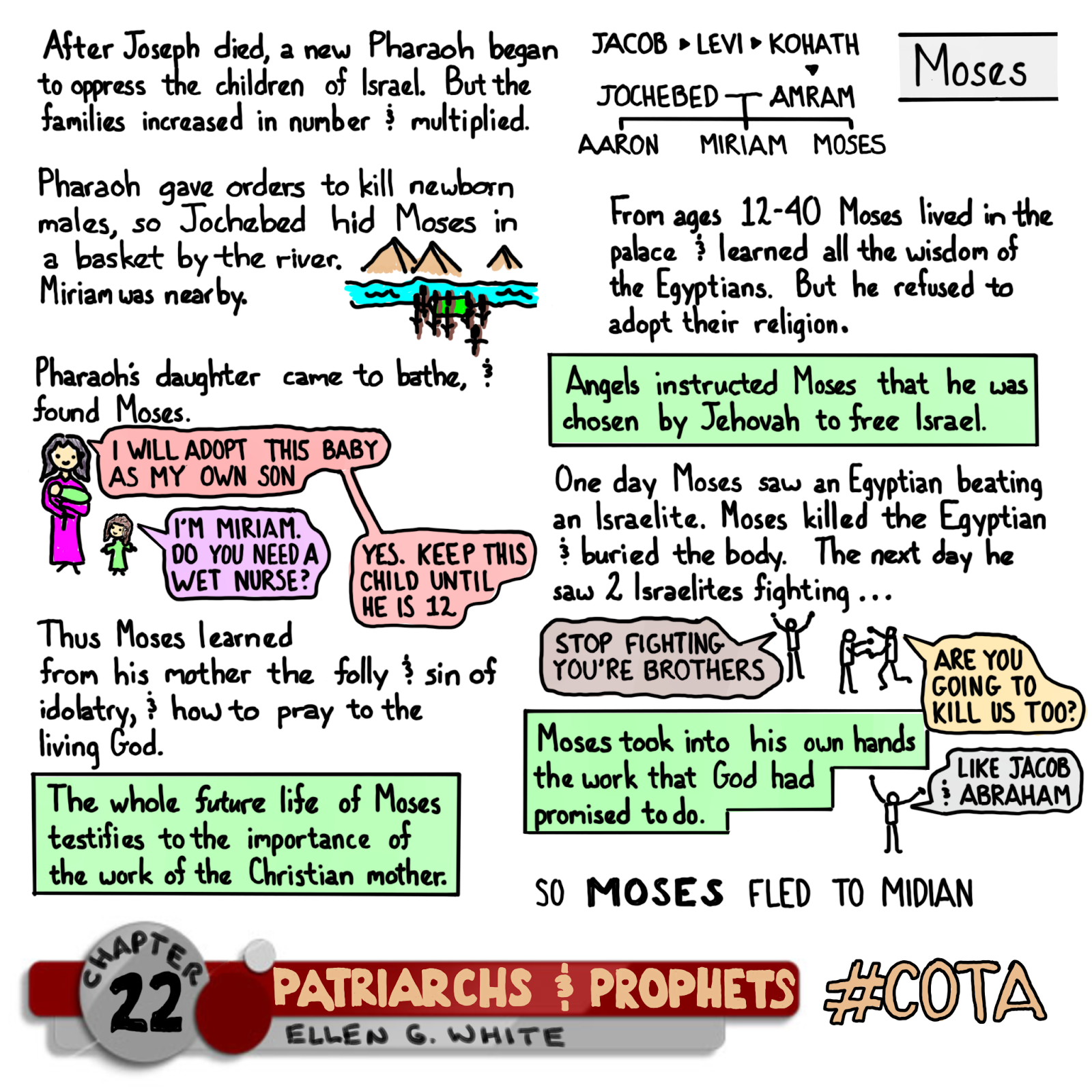
Chapter 22 - Moses


This chapter is based on Exodus 1-4.

Audio

Online Reading

THE people of Egypt, in order to supply themselves with food during the famine, had sold to the crown their cattle and lands, and had finally bound themselves to perpetual serfdom. Joseph wisely provided for their release; he permitted them to become royal tenants, holding their lands of the king, and paying an annual tribute of one fifth of the products of their labor.

But the children of Jacob were not under the necessity of making such conditions. On account of the service that Joseph had rendered the Egyptian nation, they were not only granted a part of the country as a home, but were exempted from taxation, and liberally supplied with food during the continuance of the famine. The king publicly acknowledged that it was through the merciful interposition of the God of Joseph that Egypt enjoyed plenty while other nations were perishing from famine. He saw, too, that Joseph's management had greatly enriched the kingdom, and his gratitude surrounded the family of Jacob with royal favor.


Thursday, December 7, 2017

Joseph and His Brothers

Chapter 21 - Joseph and His Brothers


This chapter is based on Genesis 41:54-56; 42 to 50.

Audio

Online Reading

AT the very opening of the fruitful years began the preparation for the approaching famine. Under the direction of Joseph, immense storehouses were erected in all the principal places throughout the land of Egypt, and ample arrangements were made for preserving the surplus of the expected harvest. The same policy was continued during the seven years of plenty, until the amount of grain laid in store was beyond computation.

And now the seven years of dearth began to come, according to Joseph's prediction. "And the dearth was in all lands; but in all the land of Egypt there was bread. And when all the land of Egypt was famished, the people cried to Pharaoh for bread: and Pharaoh said unto all the Egyptians, Go unto Joseph; what he saith to you, do. And the famine was over all the face of the earth: and Joseph opened all the storehouses, and sold unto the Egyptians."


Wednesday, December 6, 2017

Joseph in Egypt

Chapter 20 - Joseph in Egypt


This chapter is based on Genesis 39-41.

Audio

Online Reading

MEANWHILE, Joseph with his captors was on the way to Egypt. As the caravan journeyed southward toward the borders of Canaan, the boy could discern in the distance the hills among which lay his father's tents. Bitterly he wept at thought of that loving father in his loneliness and affliction. Again the scene at Dothan came up before him. He saw his angry brothers and felt their fierce glances bent upon him. The stinging, insulting words that had met his agonized entreaties were ringing in his ears. With a trembling heart he looked forward to the future. What a change in situation--from the tenderly cherished son to the despised and helpless slave! Alone and friendless, what would be his lot in the strange land to which he was going? For a time Joseph gave himself up to uncontrolled grief and terror.

But, in the providence of God, even this experience was to be a blessing to him. He had learned in a few hours that which years might not otherwise have taught him. His father, strong and tender as his love had been, had done him wrong by his partiality and indulgence. This unwise preference had angered his brothers and provoked them to the cruel deed that had separated him from his home. Its effects were manifest also in his own character. Faults had been encouraged that were now to be corrected. He was becoming self-sufficient and exacting. Accustomed to the tenderness of his father's care, he felt that he was unprepared to cope with the difficulties before him, in the bitter, uncared-for life of a stranger and a slave.